




Texas Instruments CC2650 SimpleLink Ultra-Low Power Wireless MCUs
Texas Instruments CC2650 SimpleLink™ Ultra-Low Power Wireless Microcontrollers are wireless MCUs that target BLUETOOTH® Smart, ZigBee and 6LoWPAN, and ZigBee RF4CE remote control applications. These devices are members of the CC26xx family of cost-effective, ultra-low power, 2.4GHz RF devices. Very low active RF and MCU current and low-power mode current consumption provide excellent battery lifetime and allow operation on small coin cell batteries and in energy-harvesting applications. The CC2650 contains a 32-bit ARM Cortex-M3 processor running at 48MHz as the main processor and a rich peripheral feature set, including a unique ultra-low power sensor controller, ideal for interfacing external sensors and/or collecting analog and digital data autonomously while the rest of the system is in sleep mode. This makes the CC2650 ideal for applications within a whole range of products, including industrial, consumer electronics, and medical. The Bluetooth Low Energy controller and the IEEE 802.15.4 MAC are embedded into ROM and are partly running on a separate ARM Cortex®-M0 processor. This architecture improves overall system performance and power consumption and frees up flash memory for the application.
Features
- Microcontroller
- Powerful ARM Cortex-M3
- EEMBC CoreMark score of 142
- Up to 48MHz clock speed
- 128KB of In-system programmable Flash
- 8KB SRAM for cache
- 20KB Ultra-low leakage SRAM
- 2-Pin cJTAG and JTAG Debugging
- Supports Over-The-Air upgrade (OTA)
- Ultra-low power sensor controller
- Can run autonomously from the rest of the system
- 16-Bit Architecture
- 2KB Ultra-low leakage SRAM for code and data
- Efficient code size architecture, placing drivers, Bluetooth low energy controller, IEEE 802.15.4 MAC, and Bootloader in ROM
- RoHS-compliant package
- 4mm × 4mm RSM VQFN32 (10 GPIOs)
- 5mm × 5mm RHB VQFN32 (15 GPIOs)
- 7mm × 7mm RGZ VQFN48 (31 GPIOs)
- Peripherals
- All digital peripheral pins can be routed to any GPIO
- 4 General-purpose timer modules (8×16-Bit or 4×32-Bit timer, PWM each)
- 12-Bit ADC, 200k samples/s, 8-channel analog MUX
- Continuous time comparator
- Ultra-low power analog comparator
- Programmable current source
- UART
- 2 x SSI (SPI, µW, TI)
- I2C
- I2S
- Real-Time Clock (RTC)
- AES-128 Security module
- True Random Number Generator (TRNG)
- 10, 15, or 31 GPIOs, Depending on package option
- Support for 8 capacitive sensing buttons
- Integrated temperature sensor
- External system
- On-chip internal DC-DC converter
- Very few external components
- Seamless integration with the SimpleLink CC2590 and CC2592 range extenders
- Pin compatible with the SimpleLink CC13xx in 4mm × 4mm and 5mm × 5mm QFN packages
- Low power
- Wide supply voltage range
- Normal operation of 1.8 to 3.8V
- External regulator mode to 1.7 to 1.95V
- Active-mode RX of 5.9mA
- Active-mode TX at 0dBm of 6.1mA
- Active-mode TX at +5dBm of 9.1mA
- Active-mode MCU of 61µA/MHz
- Active-mode MCU of 48.5 CoreMark/mA
- Active-mode sensor controller of 8.2µA/MHz
- Standby of 1µA (RTC Running and RAM/CPU retention)
- Shutdown of 100nA (Wakeup on external events)
- Wide supply voltage range
- RF Section
- 2.4GHz RF Transceiver compatible with Bluetooth Low Energy (BLE) 4.1 specification and IEEE 802.15.4 PHY and MAC
- Excellent receiver sensitivity (-97dBm for BLE and -100dBm for 802.15.4), selectivity, and blocking performance
- Programmable output power up to +5dBm
- Single-ended or differential RF interface
- Suitable for systems targeting compliance with worldwide radio frequency regulations
- ETSI EN 300 328 (Europe)
- EN 300 440 Class 2 (Europe)
- FCC CFR47 Part 15 (US)
- ARIB STD-T66 (Japan)
Applications
- Consumer electronics
- Alarm and security
- Mobile phone accessories
- Electronic shelf labeling
- Sports and fitness equipment
- Proximity tags
- HID Applications
- Medical
- Home and building automation
- Remote controls
- Lighting control
- Wireless sensor networks
Additional Resources
Associated Development Tools

Texas Instruments Sensor inteligente con Bluetooth CC2650STK SimpleLink™
Permite que los ingenieros de diseño obtengan ideas sobre productos conectados a la nube en un corto plazo.

Texas Instruments CC-ANTENNA-DK2 Antenna Kit (LaunchPad/Sensor Tag)
Kit that allows you to do real-life testing to find the optimal antenna for your application.
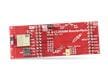
Texas Instruments BOOSTXL-CC2650MA BLE CC2650 Module BoosterPack
Plug-in module that is the quick and easy way to add BLE to your LaunchPad™ development kit.
Functional Block Diagram

Publicado: 2018-08-21
| Actualizado: 2023-04-03