




NXP Semiconductors S08QL MCUs
NXP Semiconductors S08QL Microcontrollers (MCUs) are energy efficient at a voltage range of 1.8V to 3.6V. The S08QL is perfect for cost-effective, battery-sensitive, portable, low-power applications. The S08QL family offers low-power features like two ultralow-power stop modes, and low-power run and wait modes. Other features of this NXP MCU include 6μs wake-up time, ultralow-power external oscillator, and clock gating registers to disable clocks to unused peripherals. In addition to low power, the S08QL MCU family supports up to 8KB of flash memory. The MCUs consist of an 8-bit modulo timer, a 16-bit timer/PWM (TPM), UART, RTC, 12-bit ADC and an analog comparator. This family can be powered down to 1.8V and is still able to operate at a maximum 20MHz CPU speed.
Features
- 8-Bit HCS08 central processor unit (CPU)
- Up to 20MHz CPU at 3.6V to 1.8V across a temperature range of -40°C to 85°C
- HCS08 instruction set with added BGND instruction
- Support for up to 32 interrupt/reset sources
- On-chip memory
- Up to 8 KB flash read/program/erase over full operating voltage and temperature
- Up to 512 bytes of random-access memory (RAM)
- Security circuitry to prevent unauthorized access to RAM and flash contents
- Power-saving modes
- Two very low-power stop modes
- Peripheral clock enable register can disable clocks to unused modules, thereby reducing currents
- Low power run
- Low power wait
- 6ms typical wake-up time from stop3 mode
- 250nA at 3V, +25°C typical stop current
- Clocks
- Oscillator (XOSC) - loop-controlled Pierce oscillator; crystal or ceramic resonator range of 31.25kHz to 38.4kHz or 1MHz to 16MHz
- Internal Clock Source (ICS) — Internal clock source module containing a frequency-locked-loop (FLL) controlled by internal reference; precision trimming of internal reference allows 0.2% resolution and 2% deviation over temperature and voltage; supports bus frequencies from 1MHz to 10MHz
- System protection
- Watchdog computer operating properly (COP) reset with the option to run from a dedicated 1kHz internal clock source or bus clock
- Low-voltage detection with reset or interrupt; selectable trip points
- Illegal opcode detection with reset
- Illegal address detection with reset
- Flash block protection
- Development support
- Single-wire background debug interface
- Breakpoint capability to allow three breakpoints setting during in-circuit debugging
- Peripherals
- ADC - 8-channel, 12-bit resolution; 2.5μs conversion time; automatic compare function; 1.7mV/°C temperature sensor; internal bandgap reference channel; operation in stop3; fully functional from 3.6V to 1.8V.
- ACMP - Analog comparator with selectable interrupt on rising, falling, or either edge of comparator output; compare option to a fixed internal bandgap reference voltage; output can be tied internally to TPM input capture; operation in stop3
- TPM - One 1-channel timer/pulse-width modulator (TPM) module; selectable input capture, output compare, or buffered edge- or center-aligned PWM on each channel; ACMP output can be tied internally to the input capture
- MTIM - 8-bit modulo timer with optional pre-scaler
- RTC - (Real-time counter) 8-bit modulo counter with binary or decimal based pre-scaler; external clock source for precise time base, time-of-day, calendar or task scheduling functions; free running on-chip low power oscillator (1 kHz) for cyclic wakeup without external components; runs in all MCU modes
- SCI - Full duplex non-return to zero (NRZ); LIN master extended break generation; LIN slave extended break detection; wakeup on the active edge
- KBI - 8-pin keyboard interrupt with selectable edge and level detection modes
- Input / output
- 18 GPIOs include one input-only and one output-only pin
- Hysteresis and configurable pull-up device on all input pins; configurable slew rate and drive strength on all output pins except PTA5
Applications
- Battery-powered applications
- Residential/commercial garage door openers
- Smoke detectors
- Remote window shutters
- Remote control applications
- Battery-operated toys and games
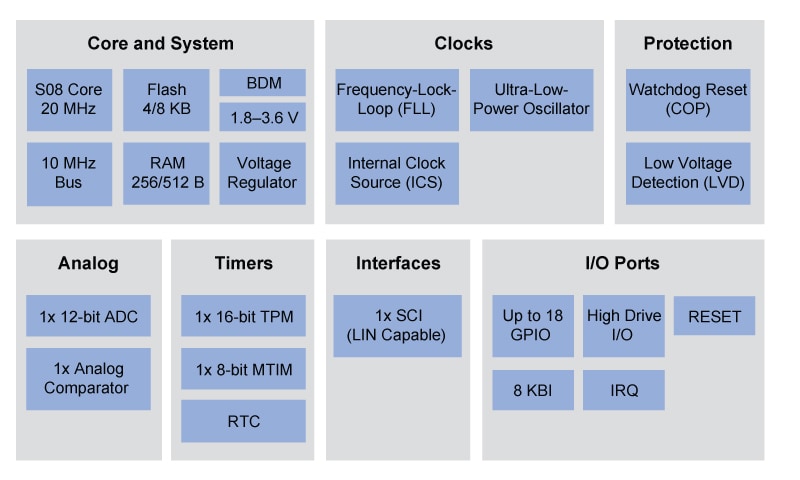
Block Diagram
Publicado: 2018-11-28
| Actualizado: 2025-06-24