




Espressif Systems ESP32-C6 Ultra-Low-Power System-on-Chips (SoCs)
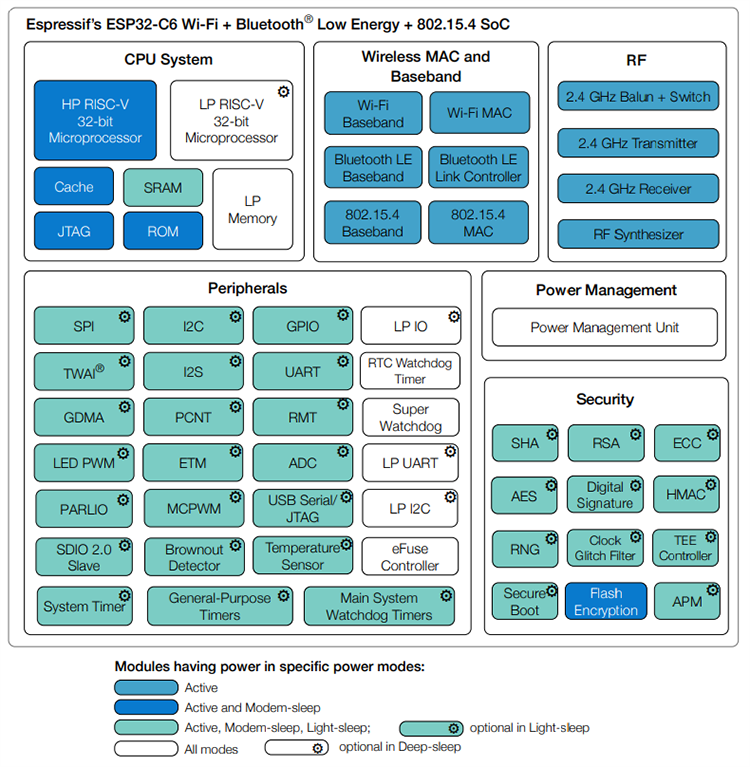
Espressif Systems ESP32-C6 Ultra-Low-Power System-on-Chips (SoCs) support Wi-Fi 6 in the 2.4GHz band, BLUETOOTH® 5, Zigbee® 3.0, and Thread 1.3. The SoCs consist of a high-performance (HP) 32-bit RISC-V processor, a low-power (LP) 32-bit RISC-V processor, a wireless baseband/MAC (Wi-Fi, BLUETOOTH LE, and 802.15.4), RF module, and numerous peripherals. Wi-Fi, BLUETOOTH, and 802.15.4 coexist with each other and share the same antenna.
Features
- Wi-Fi
- 1T1R in 2.4GHz band
- 2412MHz to 2484MHz operating frequency range
- IEEE 802.11ax-compliant
- 20MHz-only non-AP mode
- MCS0 to MCS9
- Uplink and downlink OFDMA, especially suitable for simultaneous connections in high-density environments
- Downlink MU-MIMO (multi-user, multiple input, multiple output) to increase network capacity
- Beamformee that improves signal quality
- Channel quality indication (CQI)
- DCM (dual carrier modulation) to improve link robustness
- Spatial reuse to maximize parallel transmissions
- Target wake time (TWT) that optimizes power-saving mechanisms
- Fully compatible with IEEE 802.11b/g/n protocol
- 20MHz and 40MHz bandwidth
- Data rate up to 150Mbps
- Wi-Fi Multimedia (WMM)
- TX/RX A-MPDU, TX/RX A-MSDU
- Immediate Block ACK
- Fragmentation and defragmentation
- Transmit opportunity (TXOP)
- Automatic Beacon monitoring (hardware TSF)
- 4x virtual Wi-Fi interfaces
- Simultaneous support for Infrastructure BSS in Station mode, SoftAP mode, Station + SoftAP mode, and promiscuous mode (Note: when ESP32-C6 scans in Station mode, the SoftAP channel will change along with the Station channel)
- Antenna diversity
- 802.11mc FTM
- BLUETOOTH
- BLUETOOTH LE, BLUETOOTH 5.3 certified
- BLUETOOTH mesh
- High power mode (20dBm)
- 125Kbps, 500Kbps, 1Mbps, and 2Mbps speeds
- Advertising extensions
- Multiple advertisement sets
- Channel selection algorithm #2
- LE power control
- Internal co-existence mechanism between Wi-Fi and BLUETOOTH to share the same antenna
- IEEE 802.15.4
- Compliant with IEEE 802.15.4-2015 protocol
- OQPSK PHY in 2.4GHz band
- 250Kbps Data rate:
- Thread 1.3
- Zigbee® 3.0
- CPU and memory
- HP RISC-V processor
- Up to 160MHz clock speed
- 4-stage pipeline
- CoreMark® scores - 441.32 CoreMark;2.76 CoreMark/MHz (160MHz)
- LP RISC-V processor
- Up to 20MHz clock speed
- 2-stage pipeline
- 32KB L1 cache
- 320KB ROM
- 512KB HP SRAM
- 16KB LP SRAM
- Supported SPI protocols - SPI, Dual SPI, Quad SPI, and QPI interfaces that allow connection to flash and other SPI devices off the chip’s package
- Flash controller with cache is supported
- Flash In-Circuit Programming (ICP) is supported
- HP RISC-V processor
- Advanced peripheral interfaces
- 30x GPIOs (QFN40) or 22x GPIOs (QFN32)
- Analog interfaces
- 1x 12-bit SAR ADC, up to 7x channels
- 1x temperature sensor
- Digital interfaces
- 2x UART
- 1x Low-Power (LP) UART
- 2x SPI ports for communication with flash
- 1x general-purpose SPI port
- 1x I2C
- 1x Low-Power (LP) I2C
- 1x I2S
- 1x pulse count controller
- 1x USB Serial/JTAG controller
- 2x TWAI® controller, compatible with ISO 11898-1 (CAN specification 2.0)
- 1x SDIO 2.0 slave controller
- LED PWM controller, up to 6x channels
- 1x Motor Control PWM (MCPWM)
- 1x remote control peripheral (TX/RX)
- 1x Parallel I/O interface (PARLIO)
- General DMA controller, with 3x transmit channels and 3x receive channels
- Event Task Matrix (ETM)
- Timers
- 1x 52-bit system timer
- 2x 54-bit general-purpose timers
- 3x digital watchdog timers
- 1x analog watchdog timer
- Power management
- Fine-resolution power control through a selection of clock frequency, duty cycle, Wi-Fi operating modes, and individual power control of internal components
- 4x power modes designed for typical scenarios - Active, Modem-sleep, Light-sleep, and Deep-sleep
- Power consumption in Deep-sleep mode is 7µA
- Low-Power (LP) memory remains powered on in Deep-sleep mode
- Security
- Secure boot - permission control on accessing internal and external memory
- Flash encryption - memory encryption and decryption
- 4096-bit OTP, up to 1792-bits for users
- Trusted execution environment (TEE) controller and access permission management (APM)
- Cryptographic hardware acceleration
- AES-128/256 (FIPS PUB 197)
- ECC
- HMAC
- RSA
- SHA
- Digital signature
- Hash (FIPS PUB 180-4)
- External Memory Encryption and Decryption (XTS_AES)
- Random Number Generator (RNG)
- RF module
- Antenna switches, RF balun, power amplifier, low-noise receive amplifier
- Up to +21dBm of power for an 802.11b transmission
- Up to +19.5dBm of power for an 802.11ax transmission
- Up to -106dBm of sensitivity for BLUETOOTH LE receiver (125Kbps)
- Package options
- 5mm2 QFN-40
- 5mm2 QFN-32
Applications
- Smart home
- Industrial automation
- Healthcare
- Consumer electronics
- Smart agriculture
- Point-of-sale (POS) machines
- Service robots
- Audio devices
- Generic low-power IoT
- Sensor hubs
- Data loggers
Specifications
- 3.0V to 3.6V input
- 100kSPS (kilo samples-per-second) maximum ADC sampling rate
- 2412MHz to 2484MHz Wi-Fi radio center frequency range of the operating channel
- 2405MHz to 2480MHz 802.15.4 radio center frequency range of the operating channel
- BLUETOOTH LE radio
- 2402MHz to 2480MHz center frequency range of the operating channel
- -15.0dBm to 20.0dBm RF transmit power range
- 2pF typical pin capacitance
- -40°C to +105°C ambient temperature range
Functional Block Diagram
Additional Resources
Related Products

Prokyber Esp32-C6-Bug RISC-V Zigbee® Development Board
Features the Esp32-C6FH4 RISC-V MCU, and supports Wi-Fi 6, BLE 5, Thread, and Zigbee.

Espressif Systems ESP32-C6-MINI-1 Mini Modules
Designed to deliver performance in Wi-Fi®, IEEE 802.15.4, and BLUETOOTH® LE capabilities.

Espressif Systems ESP32-C6-WROOM-1 Multiprotocol Modules
General-purpose Wi-Fi®, IEEE 802.15.4, and BLUETOOTH® LE modules.

Espressif Systems ESP32-C6-DevKitC-1 Development Board
Based on the ESP32-C6-WROOM-1 module offering 8MB SPI flash.

Espressif Systems ESP32-C6-DevKitM-1-N4 Development Board
An entry-level development board that opens up possibilities for creators and developers.

M5Stack M5NanoC6 Board
Features an ESP32-C6FH4 MCU supporting Wi-Fi 6, Zigbee®, and an infrared emitter.

Seeed Studio XIAO ESP32C6 Microcontroller (MCU)
Excels in Matter-compliant smart home applications with support for various wireless connectivity.

DFRobot DFR1117 Beetle ESP32 C6 Mini Development Board
Compact, low-power IoT development board based on the ESP32-C6 chip.

Espressif Systems ESP32-C61 Wi-Fi® 6 + BLUETOOTH® 5 (LE) SoCs
Features optimized peripherals, improved connectivity, and increased memory options.