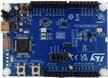

NUCLEO-WB55RG

STMicroelectronics
511-NUCLEO-WB55RG
NUCLEO-WB55RG

Fabricante:

Descripción:
Herramientas de desarrollo Bluetooth - 802.15.1 STM32 Nucleo-64 development board with STM32WB55RG MCU, supports Arduino, ST mor

En existencias: 194

Existencias:
194 Se puede enviar inmediatamente
Mínimo: 1   Múltiples: 1   Máxima: 25
Precio unitario:
$-.--
Precio ext.:
$-.--
Est. Tarifa:

Precio (USD)

Cantidad Precio unitario
Precio ext.
$47.23 $47.23

Atributo del producto Valor de atributo Seleccionar atributo
STMicroelectronics
Categoría de producto: Herramientas de desarrollo Bluetooth - 802.15.1
RoHS:  
Development Boards
STM32WB55RGVx
Marca: STMicroelectronics
Para utilizar con: Bluetooth Low Energy, Microcontroller
Tipo de interfaz: I2C, SPI, UART, USB
Empaquetado: Bulk
Tipo de producto: Bluetooth Development Tools
Cantidad de empaque de fábrica: 1
Subcategoría: Development Tools
Peso de la unidad: 340.200 g
Productos encontrados:
Para mostrar productos similares, seleccione al menos una casilla de verificación
Seleccione al menos una de las casillas de verificación anteriores para mostrar productos similares en esta categoría.
Atributos seleccionados: 0

CNHTS:
8543709990
USHTS:
8543906800
ECCN:
5A992.C

Wireless Connectivity Solutions

STMicroelectronics Wireless Connectivity Solutions are a portfolio of wireless technology products that feature specific communication ranges, power efficiencies, latencies, bandwidths, and networking topologies. These are important parameters defined by the many standard communication protocols available. With the growing importance of wireless sensor networks and Internet of Things-related devices, there is virtually no electronic system that doesn't require wireless connectivity. Typical uses are consumer to industrial applications like wearable devices, smart-buildings, home-automation, asset-tracking solutions, or medical devices. ST’s portfolio offers an extensive variety of RF solutions covering most of the key protocols and standards and proprietary radio solutions. This includes ultra-low-power RF transceivers, network processors ICs, and a comprehensive family of Wireless System-on-Chips, including pre-certified wireless modules to simplify quick adoption of those technologies. The ST wireless portfolio covers the widest range of connectivity technologies including sub-1GHz long-range networking devices (enabling LoRaWAN®, Sigfox, and Wireless M-Bus connectivity), 60GHz short-range millimeter-wave RF, Bluetooth® LE, 802-15-4, OpenThread, LTE Cat 1, and Narrowband IoT. To speed time to market, reference designs and RF modules are available as a complete development ecosystem and framework with software packages, tools, protocol stacks, example applications, evaluation boards, and quick-start tutorials. This represents an all-in-one solution for a smarter and more connected world with the most sustainable wireless technologies.

STM32WB Nucleo-64 boards

STMicroelectronics STM32WB Nucleo-64 Boards are a BLUETOOTH® Low Energy (BLE) wireless and ultra-low-power device. It embeds a powerful and ultra-low-power radio compliant with the BLE SIG specification v5.2. The NUCLEO-WB55RG offers a radio compliant with IEEE 802.15.4-2011 standard. It allows the simple and quick evaluation of STM32WB55xx devices.

STM32 Nucleo Expansion Boards

STMicroelectronics STM32 X-Nucleo Expansion Boards carry all the required components to evaluate ST devices to be used together with an STM32 MCU and to build STM32-based applications. The Expansion Boards are equipped with standardized interconnections, like an Arduino Uno R3 connector, or a Morpho connector for a higher level of connectivity. Each Expansion Board is supported by STM32-based software modules. The combination of STM32 Nucleo Boards and Expansion Boards is a unified scalable approach with unlimited possibilities for application development, prototyping, or product evaluation.

NanoEdge™ AI Studio

STMicroelectronics NanoEdge™ AI Studio is a Machine Learning (ML) technology to bring true innovation easily to the end-users. In just a few steps, developers can create an optimal AI library for a project based on minimal data and with no specific data science skills. Smarter products will detect environment anomalies, classify signal patterns and anticipate behaviors due to optimized algorithms generated from a simple PC-based GUI.